


Introduction
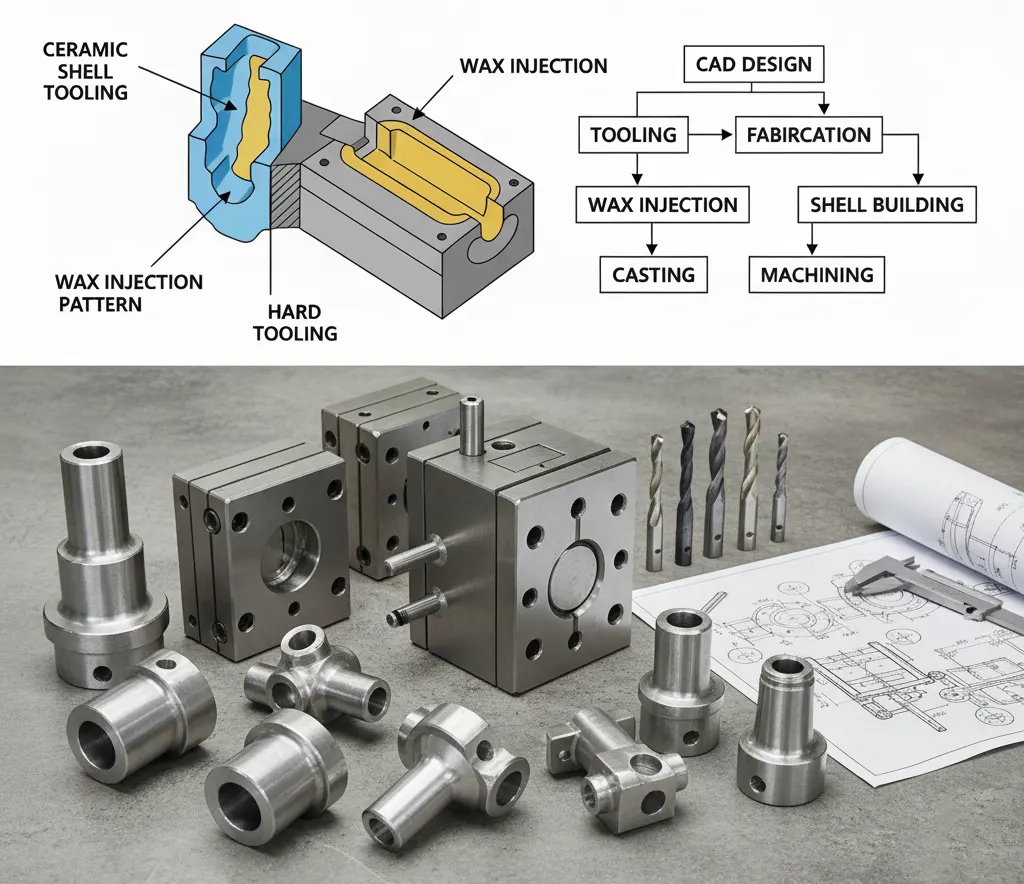
Investment casting has been a favored method for making intricate geometry with high accuracy for many years, but the true value is realized when the process is tightly integrated with machining. Parts that are precision-machined are seldom presented in the as-cast state; rather, they receive critical machining to achieve tolerances, surface finish specifications, or functional fit. Success here is not coincidental—it results from careful choices made in tooling design and a grasp of how machining and casting impact each other.
This article delves into advanced issues in machining floor and tooling design for machined investment casting, capitalizing on real-world experience from foundry practice, machining floors, and industry case applications.
The Link Between Casting and Machining
Casting and machining must never be treated as discrete operations. The instant a drawing is released, allowances for machining, the method by which a part is supported, and how metal flows into the mold are already influencing the cost, time, and quality of the finished part. Downstream operations, then, are costly correction procedures if these are not addressed upfront.
Think about a turbine casing or a precision valve body. If the casting does not offer enough stock on sealing surfaces to machine, scrap rates increase significantly. Conversely, if excessive stock is added in all locations, cycle times and tool wear increase. The art of achieving that balance is the first and most basic rule.
Building Allowances and Drafts into Design
Machining allowance is also perhaps the most contentious subject in the pattern-making process. A normal spread could be 0.5 mm on thin surfaces and 3 mm on thicker sections. But no number can function across the board; size of the casting, shrinkage of alloy, stability of dimensions in heat-treated condition all determine the ideal one.
Draft is another compromise area. Tooling needs draft for removal of wax but machining loves parallel walls. Experienced tool designers find the middle ground—maintaining minimal draft where critical machining is envisioned and yet providing greater relief in unexposed or un-machined areas. The skill is in knowing where geometry needs to be adhered to and where it can be relaxed.
Datum Structures and Fixturing Considerations
A common mistake in the design of castings is the absence of usable datum surfaces. Reliable points of reference are required in machining setups. When flat pads, locating bosses, or even sacrificial tabs are provided on the casting, machining becomes easier and much more accurate. In their absence, the machinists have to make do, resulting mostly in erratic setups and increased scatter of tolerance.
Good design anticipates clamping. Instead of forcing expensive custom fixtures, the pattern can include intentional pads that double as datum points. These are later machined away or left as hidden surfaces. Such foresight shortens lead times and reduces rework.
Tooling Materials and Master Pattern Choices
The tool quality dictates the reproducibility of each wax pattern that is created. Aluminum or steel master dies are typical, but their selection depends on anticipated life cycles. High-volume manufacturing can rationalize steel with close tolerances, whereas shorter runs can make do with aluminum or even quick prototyping paths like 3D-printed patterns.
Another frequently underappreciated activity is making up for shrinkage and shell growth. Various alloys shrink at various rates, and ceramic shells become larger when fired. The patternmaker has to work out offsets so that, after all these temperature travels, the metal cools to precisely the correct form. Here, failure means that machining stock is unreliable, an expensive issue for aerospace or defense parts.
Gating and Feeding Strategy
Regardless of how well a part is designed, bad gating can ruin the results. Gates applied to areas that later need high-precision machining create extra work and can leave behind metallurgical scars. Optimally, the gating system should supply clean metal to critical areas without having risers and gates encroach into sacrificial zones.
For intricate geometries, simulation software is used to pre-test how molten metal will fill and solidify. The information obtained dictates where additional stock is required, how to position the part in the mold, and whether hot spots will occur. By controlling these aspects, machinists deliver parts with reduced inclusions and more consistent hardness throughout the surface.
Alloy Selection and Its Machining Implications
Not every alloy is the same after cutters strike them. Stainless steels are prevalent in machined investment castings because they offer a balance of corrosion resistance and strength, but can be hard on tools. Nickel-based superalloys, which are critical in turbines or chemical processing, require stringent setups, low material removal rates, and many changes of tools.
Bronze and copper-based alloys cut differently once more. They cast well, but the smearing tendency demands appropriate tool geometry and coolant management. All alloy choices must therefore take into account not only casting integrity but also what this will entail in terms of cutting rates, tool coatings, and cycle time.
Controlling Wall Thickness and Section Changes
Thin walls are also commonly touted as a plus in investment casting, yet they can be a two-edged sword. If not sufficiently thick, the shell can break up in dewaxing or pouring. If irregular, they form stress risers that distort in heat treatment. From the point of view of machining, thin sections are usually chatter and deflect, thus it is quite difficult to achieve the required tolerances.
The main thing is to keep it consistent. The designers are trying to maintain the normal thickness of the walls in most cases, or they need to draw the gradual transitions if they are moving from thick to thin. Ribs should be at least a certain thickness, and corners should not have sharp 90-degree changes that are the most common places for stress concentration. A minimal radius works wonders both for mold strength and for cutter longevity later.
Inspection Before Machining
Investment castings, with even strict process control, can contain hidden internal problems. Porosity, micro-cracks, or inclusions are not always evident and can be revealed only when machining is done. Hence, critical applications use non-destructive testing—X-ray, CT scan, or dye penetrant inspection—before the part arrives at the machining cell.
Dimensional inspection is equally important. Coordinate measuring machines (CMMs) can check that the casting falls within the envelope anticipated for machining. If it does not, no machining allowance will save it. Catching such mismatches early saves time and tooling wear.
Machining Strategies Designed to Cast Parts
Casting surfaces differ from wrought stock. They might have oxide layers, inhomogeneous hardness, or slightly uncontrolled geometry. Effective machining techniques are aware of this.
Roughing typically employs high-feed cutters to rapidly remove stock without dainty engagement with harder surface skin. Adaptive toolpaths, based on real 3D scans of the casting, permit machines to accommodate variation so cutters only cut away material where it is.
Finishing transitions to high-speed, light cuts with emphasis on surface quality instead of volume removal. Multi-axis machining is commonly used for complicated shapes, minimizing multiple setups and enhancing tolerance consistency.
Tool Life, Coolant, and Surface Integrity
Since cast alloys tend to work-harden rapidly, tool choice becomes important. Carbide cutters with specially formulated coatings are wear-resistant but need proper feeds and speeds to prevent premature tool failure. Coolant should be able to effectively reach the cutting area, especially for cavity depths or thin walls.
Surface integrity is not just about looks. Residual stresses, micro-trends, or recast layers can undermine fatigue strength. Process engineers watch not only for dimensional correctness but also for the metallurgical state of the surface following machining. In aerospace, for instance, a surface can meet dimensional tests but still fail because of prohibitive stress concentrations resulting from bad machining practice.
Cost Balancing: Casting Complexity Versus Machining Effort
The perpetual trade-off in this area is where to put complexity. An extremely complex pattern will reduce machining but is more expensive to make and keep. A simpler pattern saves tooling cost but transfers the load to CNC machines. The best answer tends to be hybrid thinking: have casting do what it does best—complex internal passages, combined bosses, weight saving—while holding back fine fits and sealing surfaces to machining.
Economic models contrast not only direct expense but also the intangibles, such as scrap rates, lead times, and tool life. Redistribution of effort between machining and casting in most reported cases reduced total cost by double-digit percentages while enhancing reliability.
Trends Reshaping the Field
Innovation is impacting what is possible at breakneck speed. Digital simulation enables patternmakers to forecast distortion ahead of metal pouring and adapt tooling accordingly. Additive manufacturing is opening up new paths for master patterns, shortening lead times on low-volume, high-complexity work. Hybrid processes, integrating additive and subtractive phases, are becoming real contenders for niche applications.
Environmental concerns are also coming to the forefront. New systems of ceramics lower energy in shell firing, while enhanced recycling of wax diminishes waste. All these developments not only work toward sustainability objectives but also enhance cost competitiveness.
Practical Checklist for Engineers
For those who handle transferring a design from idea to manufacturing, a checklist is frequently more helpful than theoretical information alone. Before issuing any drawing for machined investment casting, engineers should ensure:
- Machining allowances are adequate but not wasteful.
- Datum features are cast in place as a stable fixturing point.
- Draft angles are suitable for both tooling and machining.
- Wall thicknesses are consistent, and transitions are gradual.
- Gating and riser positions steer clear of machined surfaces.
- Material selection balances performance and machinability.
- Non-destructive testing requirements are specified.
- CAM strategies include as-cast variation.
- Tooling material is selected for the anticipated production run.
Such discipline begun early avoids expensive surprises later on in the workflow.
Why Optimized Machined Investment Casting Matters
By making tooling and design congruent with machinability, the rewards reach beyond expense. Quality is increased, lead times are reduced, and reliability instills customer trust. From aerospace to oil and gas, industries have long understood that incompetence in this regard can doom entire projects, but perfection can build lasting advantages.
One of the companies that have excelled in implementing such integrated practices is Nectar TechnocastPvt. Ltd., whose experience proves how effective tooling choices coupled with strict machining strategy can transform challenging designs into repeatable, high-performance parts.
Conclusion
Investment casting, if followed by smart machining, provides an exclusive pair: tight tolerances and complex geometry coupled with superior mechanical properties. This result, however, is only achievable when tooling and design considerations are handled with the seriousness they merit. From gating strategy and machining allowance to alloy selection, draft control, inspection, and cutting technique, each choice reverberates.
The firms that excel at these connections open not just the gates to efficiency, but the gates to solving geometries and materials others cannot. In high-stakes competitive markets, that margin can mean winning bids versus losing out. The takeaways are straightforward: accuracy starts not at the machine tool, but in the very first strokes of the drawing, passed along through each step of tooling, casting, and machining.
