


Introduction
On initial inspection, castings seem unexciting — thick slabs of iron or alloy material, shaped into form by pouring molten metal into sand or ceramic molds. But hidden within the nuts and bolts of industrial supply chains, castings provide the foundation upon which modern economies are built. Engines turn on them, turbines spin due to them, and bridges and railways depend on them. The casting industry, that is, is not merely manufacturing but the very backbone of industry.
India is now one of the globe’s largest providers of these components, shipping millions of tonnes per year and exporting to each of the major continents. But what has altered significantly over the past decade is that Indian casting manufacturers are no longer happy to compete solely on price. They are pursuing global certifications aggressively—highly respected accreditations that bring their processes in line with global standards.
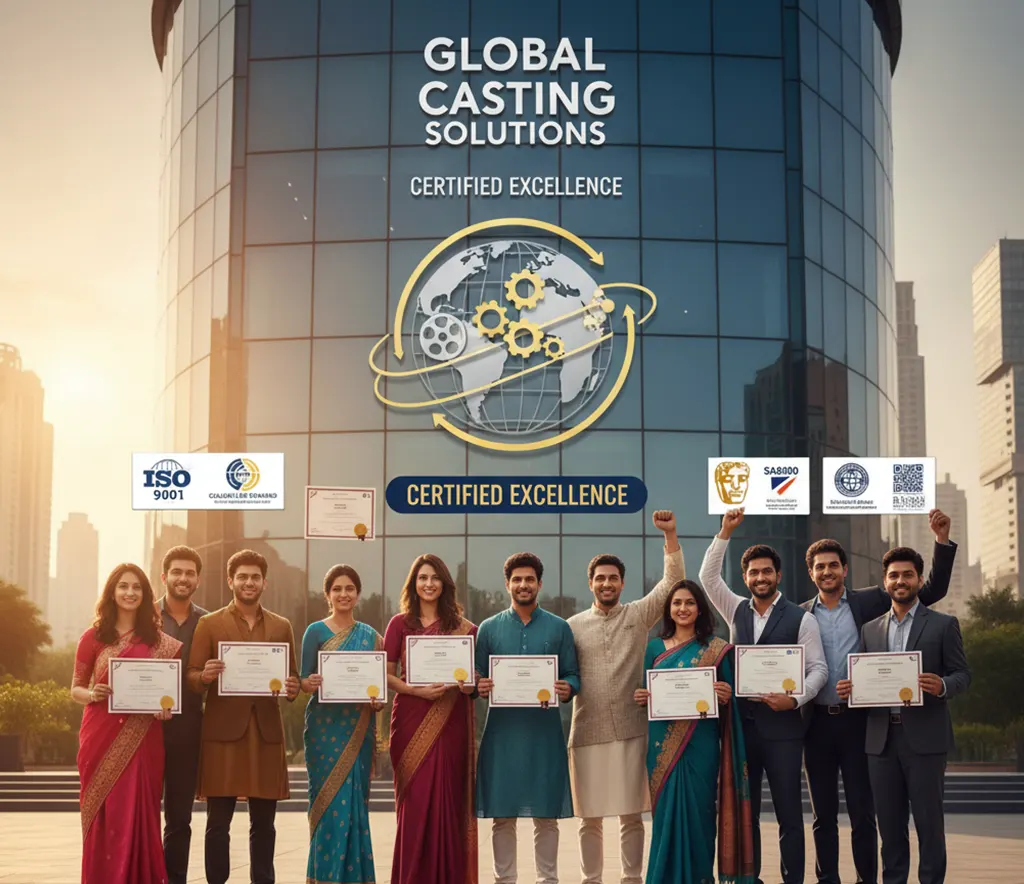
This is driven by both domestic and global demand. Buyers, especially in automotive, aerospace, and energy, now measure suppliers less by price and more by reliability. Certifications are the seal of approval. For a casting company India, compliance with systems like ISO 9001, IATF 16949, or AS 9100 is not just a box-ticking exercise; it’s a passport to the very supply chains that define the global economy.
Historical Origins, Contemporary Rebalancing
India’s foundry infrastructure has been its industrial support system. Clustered in cities such as Coimbatore, Rajkot, Kolhapur, Belgaum, and Batala, thousands of foundries met the country’s indigenous requirements of auto, textile, and agricultural machinery for decades. The quality was functional, the costs reasonable, and production volume high. Export orders were also consistent, but primarily to segments that were less sensitive to high-precision requirements.
The inflection point came as worldwide supply chains reorganized themselves. European car manufacturers, starting in the 1990s, followed by North American and Japanese consumers, subsequently started to lay down tough qualifying requirements on vendors. Indian foundries that had traditionally been dependent on low costs suddenly understood that entry into these high-paying world markets required something more than conventional efficiency—it required certified consistency.
Global OEMs signaled very strongly by the 2000s that if Indian suppliers did not have globally recognized quality certification, they would continue to be shut out from the lucrative orders. That warning reshaped the industry. Foundries started gearing up with CNC machines, CAD-CAM design systems, and automation lines. Simultaneously, they put themselves through the stringent protocols of international certification agencies. This retooling paved the way for India’s current dominance.
Certification as Competitive Necessity
In production, especially in mission-critical industries such as automotive or aerospace, errors are unacceptable. A hairline fracture of a brake part or a porosity in an engine blade can lead to failures with disastrous results. In that case, big companies will protect themselves with certain standards for the qualification of suppliers. Getting on board with IATF 16949 (automotive) and AS 9100 (aerospace) can be viewed as a guarantee that providers have undergone a check for their quality system, have implemented their standard processes, and have ensured their products are traceable.
For Indian manufacturers, these certifications have ceased to represent pride—survival. A casting company India without them cannot offer bids on contracts to top foreign buyers. Conversely, those who made the early commitment to addressing certification requirements soon rose above the “low-cost” reputation. They were viewed as serious players who could deliver at par with European or East Asian competitors.
The Global Buyer Lens
Global customers increasingly value reliability more than price. Risk elimination is paramount. A multinational auto manufacturer, for instance, cannot risk recalls due to poor castings. A similar case of an aerospace engine company cannot bet on a supplier whose quality system still lacks documentation. Even governments, in military procurement, limit tenders tightly to audited and certified suppliers.
So, in modern-day ecosystems, an uncertified vendor is invisible to the top echelon of buyers. Certifications serve as customer de-risking mechanisms. What a casting company India auditor certifies when they audit an organization, however, is not technical capability but organizational discipline. This ensures global buyers that their supplier comprehends process integrity, record-keeping, change management, and continuous improvement—the pillars of an industrial relationship that goes beyond price.
The Technology-Certification Feedback Loop
There is a symbiotic relationship between certification culture and advanced manufacturing. On the one hand, international certifications require documented evidence of accuracy; on the other, only through technology investment can that evidence be produced routinely.
Simulation-based design, robotic molding lines, automated pour control, spectroscopic testing of alloys, and ultrasound-based inspection for subsurface defects—these practices are widely permeating Indian foundries. Certifications integrate these practices into permanent expectations. The result is a virtuous cycle: investment in technology leads to certification, and certification leads to the reward of companies with access to high-end markets where such investment is rewarded.
Workforce Skilling and Culture of Discipline
No certification can hold up without an internal culture. This is why Indian casting houses have invested energy not just in machines but in people. International auditors demand that certifications cannot be documentation exercises—they must have evidence of human effort at each step. Employees need to know quality procedures, managers need to implement documentation procedures, and inspection teams need to instill measurement culture.
Training sessions and workshops are now routine in foundries that base their growth strategy on certification. An Indian casting company that reaches ISO or IATF standards is, in effect, announcing that its employees operate as an extension of worldwide systems. This cultural transformation—where traceability and precision become part of daily parlance—is possibly even more precious than the certificate itself.
Environmental Imperatives
In today’s world, global certifications are not only focused on the quality of the product but also on environmental responsibility. Since the climate objectives are significantly influencing purchasing decisions, certifications like ISO 14001 for environmental management are very important for the competitiveness of India. The energy-intensive industries, such as casting, are the ones that are most affected by the demand to show that they are environmentally responsible.
Factories now spend on energy-saving induction furnaces, waste heat recovery, and dust capture systems. They treat effluents, recycle sand, and report carbon intensity. Such compliance not only meets audits but also more and more distinguishes suppliers. Buyers derive reputational benefits from dealing with environmentally certified firms. Indian companies thus align certification with sustainability—an increasingly core connection to global trade streams.
Market Access and Sector Diversification
Perhaps the most significant benefit certifications offer is diversification. Historically, casting suppliers have focused intensely on automotive and general machinery. But aerospace, defense, rail, and renewable energy industries, which require higher-tolerance castings, have been off-limits. With AS 9100 or an equivalent standard, those doors opened.
This diversification protects suppliers from swings in the sector. For instance, when car demand falls around the world, approved suppliers can buffer themselves by supplying railway projects or windmill manufacturers. Indian companies are no longer exposed to cyclical fluctuations in any individual marketplace by expanding their sector base.
Economic Payoff
What stands out in clear terms is that certification yields quantifiable financial benefits. Certified suppliers get improved contracts, higher margins, and more sticky customer relationships. They also enjoy easier access to institutional financing, with banks and private investors considering certification as proof of governance maturity.
A certified casting company India can take initial investment in system upgrading and auditing, but the residual benefits—premium price, stability, and new market entry—exceed the expense manifold. In the long run, certification-driven companies outperform their uncertain counterparts both in revenue predictability and profitability.
Example of Industry Advancement
One such visible success story of Indian capability in certification is Nectar Technocast Pvt. Ltd., which has shown how conscious compliance with global standards can bring a foundry into the forefront of advanced global supply chains. Its journey not only shows the viability of certification but also the real credibility it lends in industry circles across the globe.
Obstacles on the Path
This realignment has not been smooth across the board. Small foundries find it difficult to meet the capital requirements of satisfying environmental or safety standards. Audits are merciless; a minor missing step in documentation precipitates compliance gaps. In addition, certifications have to be regularly renewed, generating chronic costs. However, the competitive transparency is undeniable. Without meeting these requirements, even long-established, strong suppliers can be excluded from international markets.
Industry groups and government programs have started closing gaps—providing training programs, subsidized technology upgrades, and coordinated cluster solutions where small foundries band together to address certification requirements. Such structural supports are essential in facilitating inclusivity in the industry.
The Road Ahead
India’s casting industry is in the midst of its most ambitious repositioning. Global certifications are the fulcrum by which it is breaking away from the old images of low-cost ubiquity and instead embracing roles as precision-driven, reliable partners. This shift aligns with India’s broader economic direction—competing not just on scale but on credibility.
In the next ten years, certifications will no longer be voluntary. They will become the foundation requirement in automotive, aerospace, defense, and energy ecosystems. Indian businesses that shift early gain first-mover benefit; those that are holding out risk becoming obsolete.
Conclusion
Finally, certifications are not so much about the certificate as they are about the industrial revolution they represent—discipline, documentation, environmental responsibility, and human capital building. To a casting company India, such accreditations are more than notices to purchasers; they are vows to a new mode of operation, one based on global citizenship of manufacturing.
